Tag Archives: Ebola

Second Ebola Update

It has been a month since I last posted an update on the Ebola Virus disease (EVD) in my country. The first update was on August 21. Well, at this juncture, it seems perfectly reasonable to me to post another update, although I am aware that people are reading or hearing about the virus on the Internet and on international media outlets.
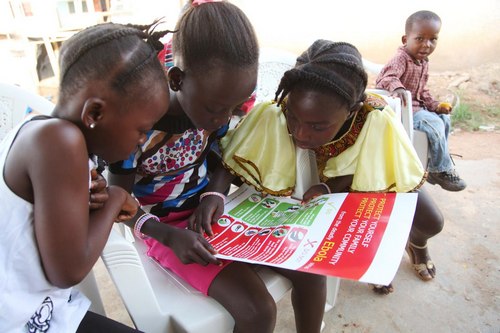
Girls reading Ebola awareness poster (Photo: UNICEF)

Girls reading Ebola awareness poster (Photo: UNICEF)

My dear friends, the spread of the virus is getting graver and graver by the day and the number of deaths emanating from the virus is increasing unbelievably exponentially. It is troubling.

When the presence of the virus was detected or reported sometime in March, we heard of only one county (Lofa County) having cases of the virus. But hear the startling revelation. The Ministry of Health of the Liberian government announced yesterday that of the fifteen (15) counties Liberia is comprised of, fourteen are now affected by the virus. It is terrifying.

Not only that. The number of deaths is also staggering. It is discouraging and terrifying. A few months ago, we were only hearing about a few deaths. Today, the situation is different. Just yesterday, too, the Ministry of Health reported that 1,500 persons have died of the virus so far. Can you imagine? But hear this. It is a known fact that the number of deaths is under-reported. What does this tell you?

Another sad situation contributing to the increase in the death rate is the lack of enough space for people having Ebola or suspected of having Ebola. No space – and no beds – for many people who go or are taken to the various Ebola holding centers for admittance or treatment. They are rejected by these treatment centers. Many of these people are seen standing or sitting in front of these centers hopelessly helpless. It is pathetic. Some of them die right in front of the centers. There are numerous heart-breaking scenes and stories all around.

But it also has to be said that not all those who have died actually died of the Ebola virus. Sadly, those collecting dead bodies do not, generally speaking, distinguish between Ebola-related bodies and non-Ebola bodies. Almost all bodies are treated as Ebola bodies, and these bodies are either cremated or buried some kind of way. It is sad – really sad. For example, people dying of cholera or diarrhea or some other illness are buried like Ebola bodies. It is painful for relatives and friends left behind.

There is also another hopelessness associated with the spread of the virus. And that is most health centers and workers are refusing to accept or treat other patients that go to them. The reason? The patient could be carrying the Ebola virus. Diarrhea patients are rejected. Cholera patients are rejected. Malaria patients are rejected. Pregnant women and girls in labor pain are rejected. Some of them give birth in cars, in the street or in front of hospitals. It is sad and shameful. Pressure patients are rejected. People suffering from stomachache are rejected. Many people are dying unnecessarily in this land. And guess what? When these people die, they are treated as if they were Ebola patients. It is a horrible situation.

Another problem most Liberians find themselves in during these difficult times is the increase in the prices of many commodities. In fact, the Ministry of Commerce announced publicly a few days ago that Liberians should expect increase in the prices of basic commodities, especially food and petroleum. The price of a bag of rice has already gone up. It is not easy. Not only have things been tough on many people, it is actually getting tough on more people.

In all this, this is what we can say for now: “God, have mercy and save our land.”

Updates on the Ebola Issue

First of all, my profound thanks to all of you who are concerned about the Ebola situation in our country and continue to remember us in your prayers. Some of you call or write to check how things are going and how we are doing in this crisis. I will make special mention of Catherine Gill-Jamieson, Elizabeth Thorne, David Turner, Lena Marner, Mary Smith, and Anders Marner. We appreciate your concern for humanity.

“Ebola Is Real” sign in Monrovia, Liberia (Photo: UN)

At this junction, permit me to provide some information on the Ebola issue in our country.

From all indications, it is safe to say that things are NOT getting better. Why do I say this? Well, first, there was no state of emergency. Then a state of emergency was announced. Second, there was no curfew. Now, one has been announced, and it is for the entire country, not just the capital city or a few cities. Third, two townships (one in Montserrado and one in Margibi) – West Point and Dolo Town – have been quarantined. Besides, not only are more and more people believed to be contracting the Ebola virus, but also more and more people are dying of the virus or suspected of dying of it. Fourth, the virus is spreading to more regions. For example, from the onset, the point of concentration was Lofa County. Now, we do not only talk about Lofa; we also talk about Montserrado, Bong, Bomi, Nimba, etc. Fifth, many individuals and institutions, including NGOs and members of the Liberian Legislature, are blaming/criticizing the government for doing little or nothing to prevent the spread of the virus or to help people who have contracted it. Surely, these are NOT signs that things are improving.

There was a clash between the residents of West Point and Liberian security forces yesterday (August 20). At least three people were seriously injured in the process. There are also reports that the prices of basic commodities increased in certain quarters, especially in West Point.

Another problem associated with the fight against the virus is the series of inconsistent and – sometimes illogical and irresponsible – pronouncements or information coming from the government or those connected with it. For instance, President Sirleaf announced a few weeks ago that all Ebola-related dead bodies should and would be cremated because, according to her, burying the bodies would contaminate our wells, waters, etc. But guess what? Dead bodies are being buried instead of being cremated. No one, not even the President, is talking about cremation anymore. The new argument is that the Ebola virus does not survive for long outside a living tissue — that it dies when the body is buried. But if this is true, then why did the President say that burying the dead body would contaminate our wells, waters, etc?

Anyway, there is some good news. For example, some of those who contracted the virus and were given early treatment at Ebola Isolation Centers have recovered, and they have been sent home. Some of them have spoken on the radio and on television. This, to me, indicates that if seriousness and cautiousness are applied, the virus can be kicked out of our land quicker than expected. Besides, more and more people are observing the safety measures announced by the government and our health workers.

It’s also worth mentioning that all schools, including colleges and universities, are closed for now. The government has announced that it will inform school authorities when schools should reopen. As indicated above, the government has imposed a 9pm-to-6am curfew in the country. It also announced that all video clubs and entertainment centers should be closed at 6pm. Also, not all those who are employed are going to work. Most of them, including those working with international non-governmental organizations, have been told to stay at home, saying that only “essential staff” should go to work.

By the way, many people are experiencing some very tough times during this period. In other words, things are very hard these days for a lot of people.

That’s all for now. More updates later — that is, if I manage to get online.

Note: In the next few days we will post an update on the annex project fundraising thus far. We register our apology for our inability to have done so by now.

Written by Paul Yeenie Harry (+231 880619323)